 Fix.bg
Fleet management: a practical guide to maintenance and documents
Fleet management is about much more than knowing where your vehicles are. A late oil change, an expired insurance policy or a missed inspection is expensive: repairs, fines, and vehicles that stand still instead of working. This guide covers what fleet management involves, which deadlines to track and how to bring order to them without wasting time.
What fleet management is
Fleet management covers everything a company does to keep its vehicles and machinery roadworthy, legal and cost-effective. It usually includes:
- Maintenance: oil and filter changes, tyres, brakes, and servicing machinery by engine hours.
- Documents and legal deadlines: insurance, technical inspections, vignettes, tachographs.
- Costs: what each vehicle costs to maintain, and which ones are getting expensive.
- Tracking and mileage: where each vehicle is and how far it has driven, usually with GPS.
- People and responsibilities: who drives, who takes care of servicing, who needs to know.
Many companies already have GPS tracking, but maintenance and documents still live in notebooks, spreadsheets and one person's head. That's exactly where deadlines get missed, and it's the part of fleet management this guide focuses on.
The deadlines every fleet must track
Every vehicle comes with two kinds of deadlines: those that depend on mileage (or engine hours for machinery), and those tied to a date. Here are the most common ones:
| Deadline | Tracked by | Watch out for |
|---|---|---|
| Engine oil & filter | By kilometres; machinery by engine hours | The interval depends on the manufacturer and the workload. City driving and heavy loads shorten it. |
| Air, fuel and cabin filters | By kilometres | Often changed at different mileages from the oil, so track each one separately. |
| Civil liability insurance | By date, usually yearly | Driving without it means fines, and after an accident, costs you carry yourself. |
| CASCO insurance | By date | With an expired policy, any damage is at your own expense. |
| Technical inspection | By date | How often depends on the vehicle category and age. |
| Vignette | By date | E-vignettes come with different validity periods, so track the date for each vehicle. |
| Tachograph | By date | A periodic inspection is required at least every 2 years. |
| Tyres | By season and wear | Plan the seasonal change for the whole fleet in one go. |
Always check exact intervals in the manufacturer's manual, and legal requirements in the current regulations.
What a missed deadline costs
- Repairs. A skipped oil change speeds up engine wear, and an engine repair costs many times more than a service.
- Fines and paperwork. An expired policy, inspection or vignette means fines at a roadside check, and after an accident, costs no insurer will cover.
- Downtime. A vehicle stuck in the workshop or by the road earns nothing, and an idle truck or excavator can hold up a whole project.
- Time. The hours someone spends calling drivers and digging for when something was last done cost money too.
Why spreadsheets aren't enough
A spreadsheet is a good start, but for fleet management it has some serious gaps:
- It doesn't remind you. If nobody opens it, the deadline passes unnoticed.
- The odometer goes stale. Mileage deadlines depend on the current reading, which changes every day.
- It lives with one person. When they're on holiday, nobody knows what's coming up.
- There's no history. When the timing belt was changed, what the repair cost and where the invoice is are hard to find.
5 steps to orderly maintenance
- List every vehicle and machine: plate, make, model and type. Include machinery tracked by engine hours.
- Record the exact current odometer, read from the vehicle's dashboard, not from memory. Every mileage deadline is calculated from it.
- Note when each service was last done and when each document expires, separately for every item.
- Decide who gets the reminders: the manager, the mechanic, accounting. Everyone should know what's coming up for their vehicles.
- Make it a habit: log work as soon as it's done, and keep odometers current, by hand or automatically through GPS.
Odometer: by hand or with GPS
Mileage reminders are only as accurate as the odometer reading. There are two ways to keep it current:
- By hand: update the odometer every 2–4 weeks. Fine for smaller fleets and vehicles that don't drive much.
- With GPS: if your vehicles are already tracked, odometers and engine hours can update automatically, so mileage deadlines stay accurate without anyone typing numbers.
How Fix.bg helps
Fix.bg is fleet management software built for exactly this part of the job: maintenance and documents, where deadlines are missed most often.
- Every deadline in one place: by kilometres, engine hours and date
- An email every morning at 8:00 with what's overdue or coming up
- “Mark as done” straight from the email, without logging in
- Integrations with leading GPS providers for automatic odometers
- Fast even with hundreds of vehicles
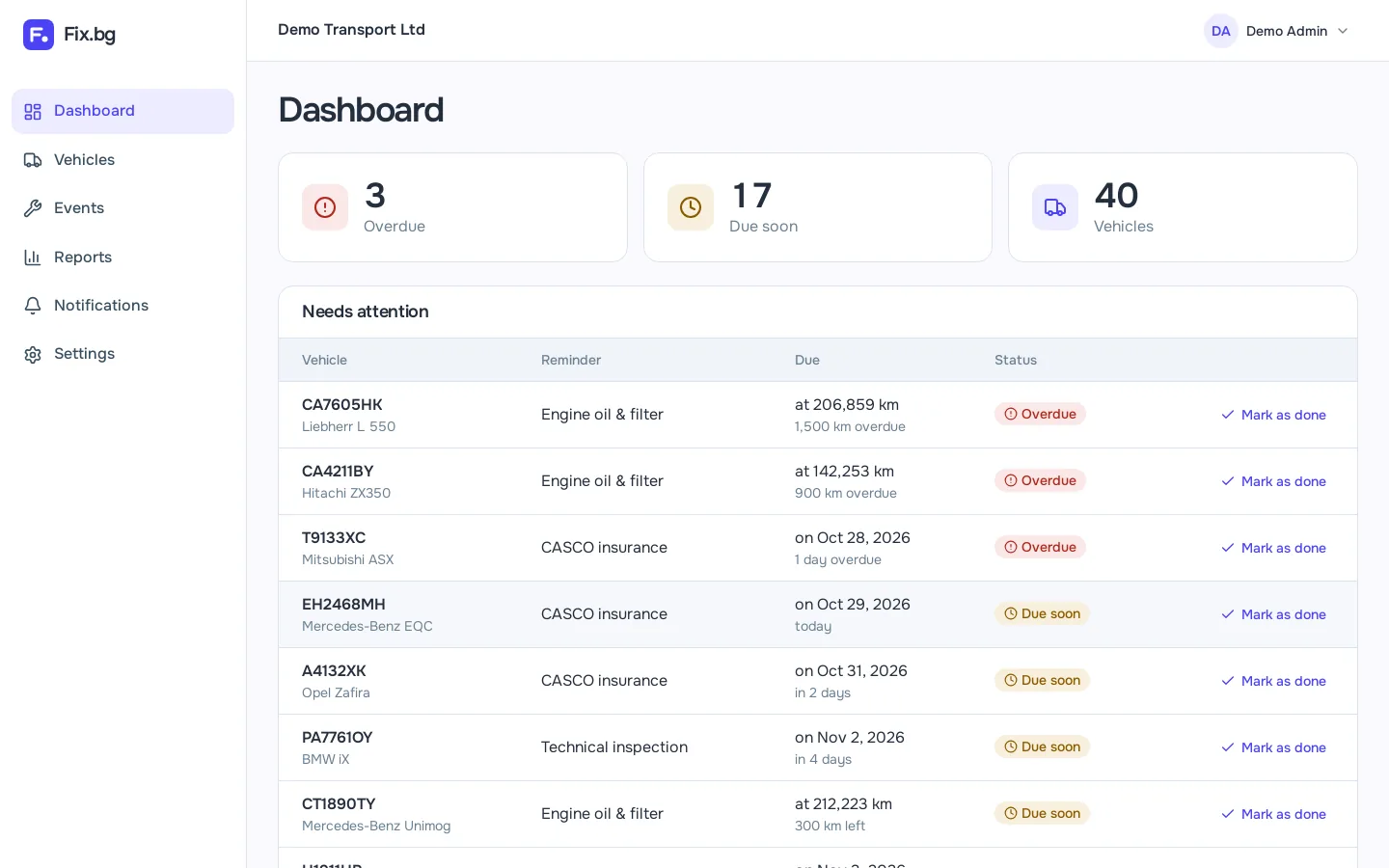
Try it with your own fleet: €0.90 per vehicle a month, first 3 free.
Frequently asked questions
What is fleet management software?
An online system where a company keeps its vehicles and machinery: maintenance, documents, costs and mileage. Good software doesn't just store the information, it tells you what's coming up.
How often should the oil be changed?
As the manufacturer specifies for the vehicle and how it's used. For cars it's often somewhere between 10,000 and 30,000 km or once a year; trucks and machinery use their own intervals, machinery usually in engine hours.
Do I need GPS tracking for fleet management?
Not for maintenance and documents. They can be tracked with an odometer you update by hand. GPS saves the typing and makes mileage deadlines more accurate.
From what fleet size does software make sense?
From just a few vehicles. Deadlines multiply quickly: 5 vehicles with 5 reminders each is already 25 dates and mileages to remember. In Fix.bg the first 3 vehicles are free.